

Taken from 2 Samuel 21
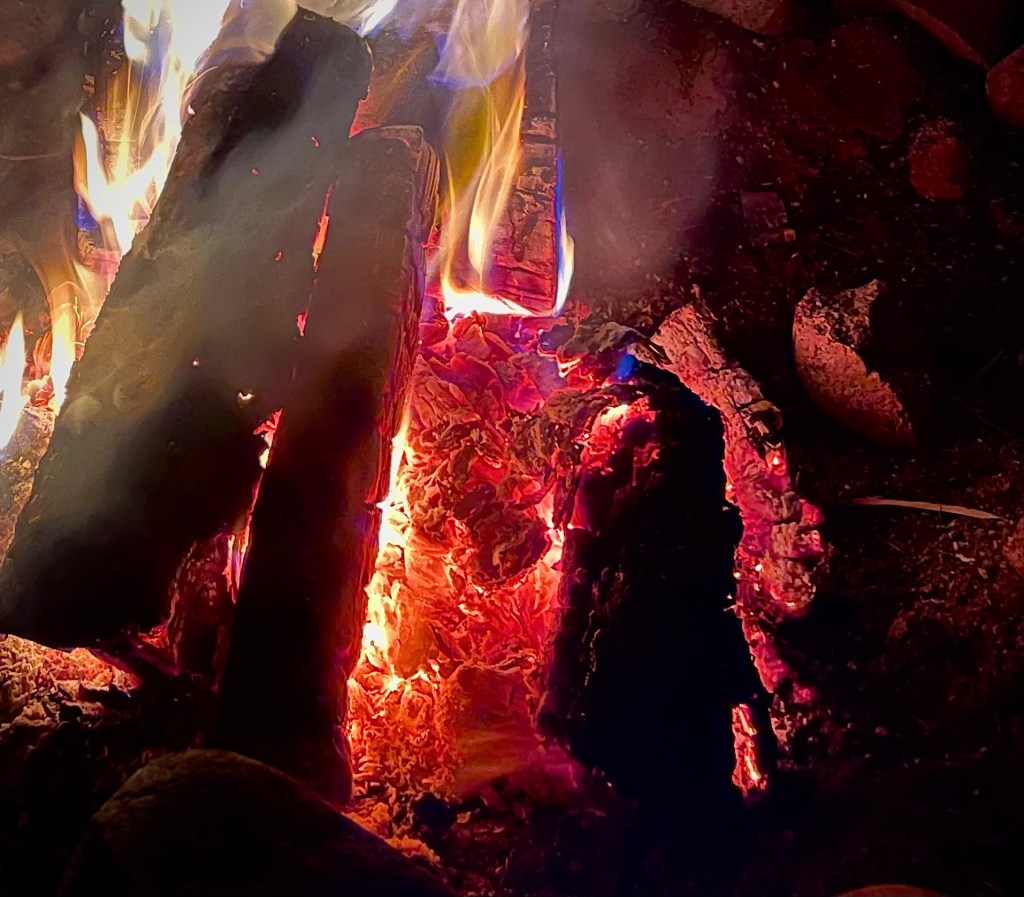
I find her on a barren hillside, her still dainty form easy to miss next to the crude stakes she sits below with their gruesome, decomposing bodies. She’s found a boulder to scramble up on for safety near her two sons’ silhouettes, and all she has to pass the night with is an uncomfortable, scratchy blanket made of goat’s hair and a fire to keep predators at bay. Her feet are bare and dirty – her face a smear of ash and sweat and tears. The dark waterfall of her hair that once caught Saul’s eye is now tinged with gray and hangs in grimy strands around her face. It’s nothing like its usual, sleek sheen – and she doesn’t even care. Those things she took pride in no longer matter.
I can tell, even from where I stand outside the city gates, that she’s barely clinging to sanity. There’s something otherworldly about her – as if one foot rests on the other side of death – as if she’s only half in this world now. It’s a scene straight out of the dark Grimm’s brothers fairytales – something you might see in a film like Willow with hanging gibbets and ravens picking at skeletons, and it makes the hair on the back of my arms stand up.
There’s long moments of silence out here as she sits on her boulder, watching the hillside, keeping her gaze pinned to the boys – on guard against any wild animal or desperate criminal that might think to scavenge from them. All I can think as I watch her is that she’s fearless. And maybe a little crazy. She doesn’t care if she lives or dies. She has nothing left.
As the hot days pass, I am in awe of her, of her core strength – of her determination to stay out here in the famine wrecked land, keeping the dead company for what some say is up to five months. I can’t imagine it. Keeping vigil next to the smell and the sight of decomposition coming from the ones you love. Braving the elements alone, including the wild animals. Especially after the life she’s led, the coddled, royal life. My heart twists at the sight of all her intensity; that absolute, empty, loneliness she exudes. I wish I could do something, but I watch her from a distance. She doesn’t want my company – or that of anyone at all.
Not even him. Maybe especially not him.
She doesn’t see him as he stands with her. As he follows her and guards her back. The way his eyes are pinned to her.
In the beginning, when blood still dripped down the wood, she would stop now and then and press her cheek to the side of one of her son’s feet, tears streaming down her cheeks in silent agony. Why would he let it happen? Why would he demand her boys lives to end a famine? How could he do it? She stared up at their still young faces, the two gifts she’d gotten from God and given to Saul. Two young men disposed of so callously, so indifferently, when they’d barely had a chance to live. They weren’t even considered Saul’s legitimate offspring. They were supposed to grow old and outlive her. She can’t understand her God – why he’d tell David what he did. But she won’t walk away from the hill in despair. She’ll battle both David and God until her final breath if she has to – to protect her sons, to honour them and keep them from disappearing into the hillside as if they’d never lived. As if they didn’t matter.
Sometimes she screams herself hoarse to chase off the vultures, the crows. Her fury and desperation is palpable as the birds crowd the sky incessantly, staying just out of reach, hopping closer the minute she rests. She can express her rage then, in those screams; at the men who decided what God thought; at the senseless brutality of David’s choice; the bloodthirsty revenge of the Gibeonites; and the unthinking, selfish ego of Saul that brought such unending tragedy to all their lives. Maybe most of all at the stubborn silence of a God who is too easily misinterpreted and misunderstood and used up in power plays. Who at worst made a bargain for blood spilled to stop a famine, or at best stood back and let it happen.
But her grief is another thing, a silent, hollow thing that seeps in when she stops screaming. She won’t speak to anyone who ventures near – she won’t be comforted or coddled or pulled away. It breaks her again and again when she looks up and sees the husks of her boys hanging there. When she remembers holding them to her breast, watching them grow. Bodies left to rot, exposed to the sun as they decompose – as if they’re nothing but a curse – distilled into their father’s sins, rather than cherished in her love. She wasn’t even allowed to bury them, and the thought of that makes her fists clench and she screams at the birds again when she can’t hold it in any longer.
I don’t know why, at first, that I’m drawn to her. Why this weird and gory story pulls at me again and again. She’s barely a footnote in David’s big, heroic tales – just a crazy widow with hardly more than a paragraph. There’s not enough information about her: only that she was a concubine – a desirable woman but not valuable enough to be a wife; that a man took her and slept with her after Saul died just to prove he could; that her two sons were slaughtered by David in a bid to stop God’s famine and pay for Saul’s sins. Can you hear the tragedy of her life in those few sentences? The way she was unseen, the way she was used?
All these men that interpreted and misinterpreted God’s will around Rizpah, outside of her control, that used her and took her body and then took her children. Who saw her? … Who noticed her?
As I watch her fight, I mull it over, drawn to her name. Rizpah – a strange sounding mix of syllables on my tongue, a combination of Hebrew verbs: ratsaph, meaning to fit together without gaps and resheph: a glowing/live coal. Most scholars say it meant a “cooking stone.”
But when I look into the clues hidden in those old stories, I am captured by the verb resheph – used when a Seraphim pulls a glowing coal from the altar and touches Isaiah’s lips, burning away the accusation inside the prophet’s heart that his lips were unclean, and he was unfit to be in the presence of his God. It was a fiery coal that somehow burnt away his fear and his shame; helped him remember that he was safe and loved by his God, gave him the peace to stay and listen and be at one with his God. It’s the same verb also used when an angel made food over live coals for Elijah while he slept – to give him strength to walk his long road through the desert until he found his God.
That’s when I see it – how she glowed like that live coal. How she refused to give up on the respect due her sons’ bodies. How she stayed visible on that hillside, a defiant spark against the dark, focused on protection, determined not to turn away from the mess of it, from the pain of it. She didn’t take them down. She didn’t wail at David’s feet. She didn’t spread rebellion and hate. She only stayed with them. She was love, and in that grief she was also a soft rebuke to the senseless cycle of killing. To a god who might condone it and demand it. Her fierce, relentless heart was an ember that worked its way through the city of Gibeah until it found its way to David’s lips. She reminded him of what love and respect looked like. Of the worth in those bodies that had carried God’s treasure inside them. Rizpah made David remember his brotherhood with Jonathan and his respect for Saul – the way God had chosen Saul first. It was Rizpah’s silent, intense protection and her unwavering focus on what mattered that provoked David into going out and collecting them all – Saul and Jonathan and their boys bringing them all to a proper grave.
I think Rizpah is God’s heart in this part of the story. She exposes where Jesus stood in the senseless massacre that just goes on and on between men who use God to kill and take revenge. He’s standing guard with that crazy widow, in the smoke and the scent of death and the agony of grief. Watching with intense concentration those who’re tossed away as afterthoughts. Keeping company with the dead and the innocent. Looking into and noticing the fire in the concubine that had been passed around and looked over…
What if Rizpah is what ended the famine – not David, not the “just” killing?
I think Jesus sat with her as she screamed and shivered, stood on that hillside while she pummelled him with her fists and her fury and protected her as she broke. I think he waited until she was ready to let go, until enough time had passed that it couldn’t have been in answer to David’s actions. And then he sent the rain, the soft embrace of water to wash away the ashes, the scent of death, to wipe her tears away. Jesus saw Rizpah. He watched her glow as she pieced love and rebuke together into a hot coal for Gibeah and David. He held that coal with her. Didn’t turn away from her fury and her grief. He bore her accusations, her pain. And in that strange redemptive circle of his, maybe he let a concubine help save Gibeah (see Judges 19-21 for reference).
 Once Upon the Ink
Leave a comment